
Hazard Identification and Risk Assessment
“The Science of Preventive Safety and Operational Continuity”
Course description
In the high-stakes environments of electrical and mechanical engineering, hazards are often invisible—ranging from stored energy and chemical toxicity to structural fatigue. A HIRA competency is the most critical tool a supervisor or technician can carry. This course transforms safety from a reactive accident investigation into a proactive prevention strategy, empowering staff to identify risks before they lead to injury or downtime.
Course outcomes
Upon completion of the training, participants will be able to:
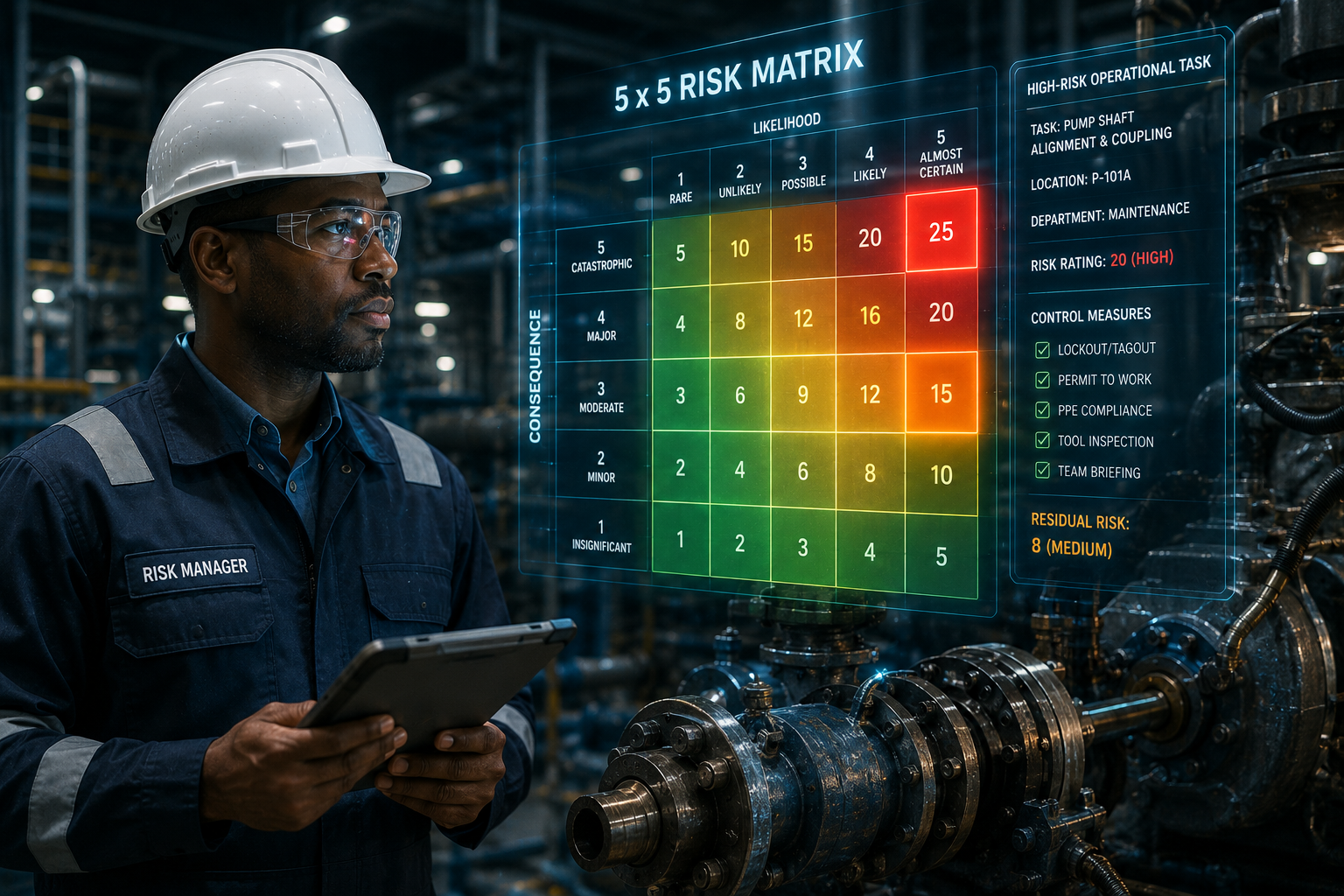
- Define the Risk Relationship: Apply the fundamental risk equation (Risk = Likelihood x Severity) to evaluate workplace dangers objectively.
- Conduct Three Levels of Assessment: Execute Baseline, Issue-Based, and Continuous risk assessments tailored to specific electrical or mechanical tasks.
- Utilize the 5x5 Risk Matrix: Use standardized qualitative and quantitative tools to rank hazards and prioritize maintenance interventions.
- Apply the Hierarchy of Controls: Select the most effective safety interventions—moving from Elimination and Substitution to Engineering Controls, Administrative Controls, and finally PPE.
- Identify "Hidden" Hazards: Detect non-obvious risks in technical environments, such as stored elastic energy in springs, chemical volatility, or latent electrical faults.
- Draft Safe Operating Procedures (SOPs): Translate the findings of a risk assessment into clear, step-by-step technical instructions for field staff.
- Audit "Reasonably Practicable" Measures: Evaluate whether the time, cost, and effort of a safety measure are proportionate to the risk, ensuring both legal compliance and operational efficiency.
- Digitize Risk Documentation: Use Windows-based templates to create a searchable, digital library of risk assessments for internal audits and Department of Labour inspections.
Topics to be discussed:
- Module 1 - Introduction to OHS
- Module 2 - Identification of hazards
- Module 3 - Intro to HIRA (What and Why)
- Module 4 - Conducting a Risk Assessment
- Module 5 - Managing Findings
Who should attend:
- Electricians & Wiremen
- Mechanical Fitters
- Technicians & Artisans
- Health & Safety Officers
- H&S Representatives
- Risk Managers
Benefits of attending:
- Mastery of the Hierarchy of Controls to select the right safety intervention.
- Understanding the calculation: Risk = Likelihood x Severity.
- Ability to transform safety from reactive "investigation" to proactive "prevention".
Course Content
Pre/Post Training Questionnaire
You don't currently have access to this content